Label 40 images. Get a detector that finds what you asked for, on your own imagery, in days. Tested on 39 public datasets we didn’t pick — it worked on every one.
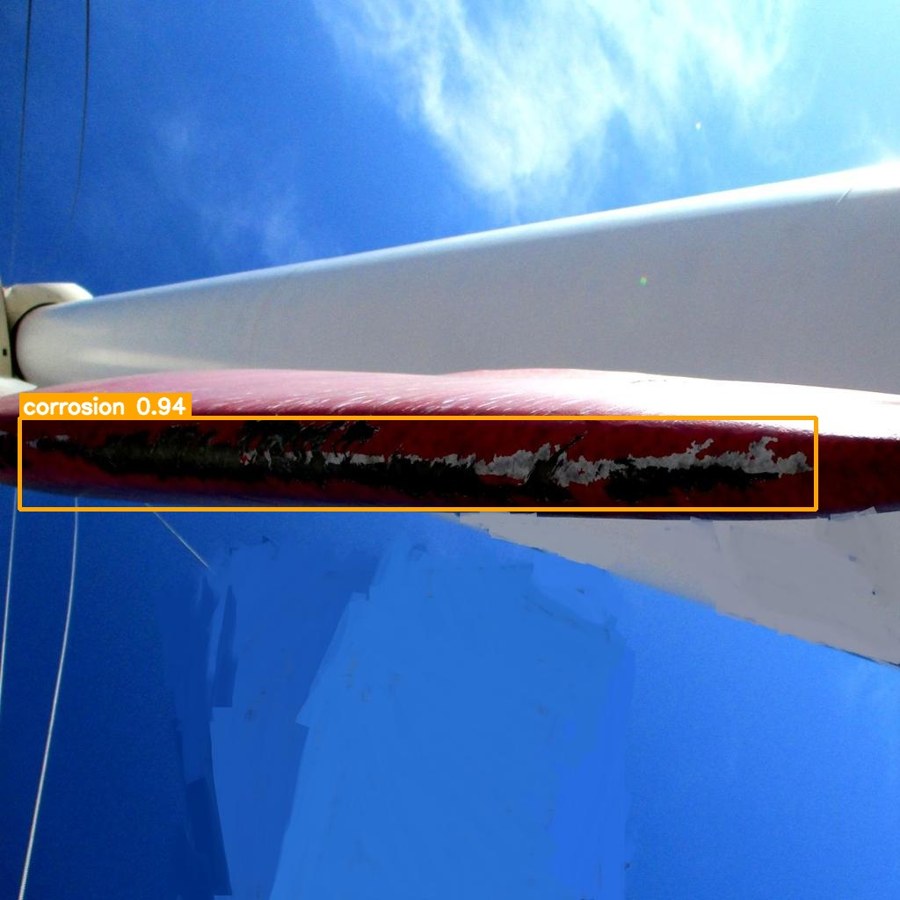
See all 39 datasets →Assets first, then damage. Every box is a real detection on a held-out frame.
Pass mark set before we ran: under 55% of a fully-labeled model counts as a failure. Zero of 39 hit it — no per-domain tuning, no architecture changes.
Every percentage is measured against a model trained on that task’s entire labeled dataset — the annotation project you would otherwise be paying for. Forty images gets you most of the way there.
Same 40-image recipe in all three. What changes the score is how big the object is in the frame, not what the camera was bolted to — so tell us the camera and the standoff distance and we will tell you where you will land before you buy.
Finding the asset is the easy half; the value is in the damage — rare, subjective, and expensive for an expert to box. Same recipe, unchanged.
Four industries, one system, nothing rebuilt between them. The cable break at 60% is the weakest and it is here on purpose — thin, low-contrast damage on a busy background is the hardest thing we do, and you should see it before you buy.
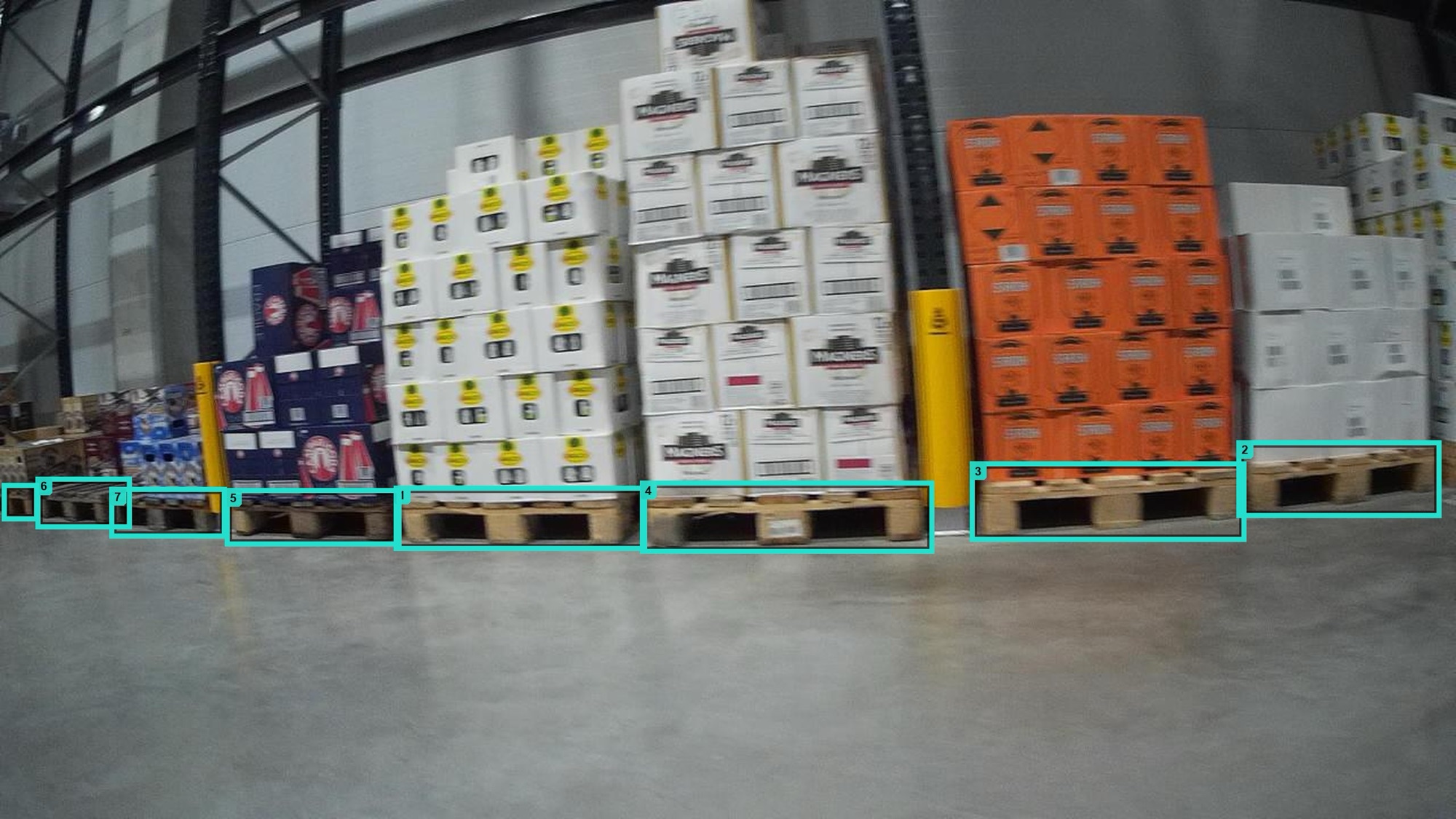
A box on an image is not a business outcome. Every detection leaves as a structured record — what it is, where, how confident — in open formats your systems already read.
Stock counted per frame, per aisle, per bay. On a fixed camera, averaging a handful of frames cuts count error to 11–13% — without touching the detector.

One dial, three modes: cast a wide net for review, run balanced, or flag only what it is certain of. You choose where the false-alarm cost sits — not us.

Boxes, counts, classes and confidences in open, standard formats — inventory systems, work orders, GIS, compliance logs. Nothing has to move to a new platform.
Three phases, one loop. An agent runs it end to end — on your hardware or in your own cloud. We stand it up with you; after that it is yours to run.
Upload imagery. Get a structured inventory of the classes you care about.
A brand-new asset onboarded in days from 40 images per site — and multiple assets come out of that one pool of 40.
Anomalies flagged with confidence scores. Work orders and compliance evidence packages generated autonomously.
Assets, novel assets and defects — detected, self-improved, delivered in open formats. Held-out across 22 public datasets, the loop improved the deployed detector 20 times out of 22, closing a typical 18% of the remaining gap with no further labelling on your side.
A fixed, hand-labelled model starts drifting from field conditions the day it ships, and the usual fix is another labelling round. Yours ships with a research scientist instead. It reads the literature, finds the methods worth trying on your problem, designs the experiment, runs it overnight on your hardware, and keeps only what raises the score — then goes again. One recent experiment lifted accuracy by 4.4 points. Nobody asked it to.
New work appears constantly and almost none of it applies to you. The agent reads it against your results and your imagery, and shortlists what is worth an experiment.
It builds the experiment, runs it against your held-out data, and measures the result — with no ML engineer of yours in the loop and nothing leaving your network.
See what changed, what it was measured against, and by how much. Then approve or reject.
That is the half that improves the model. The other half improves the data — the auto-labelling flywheel mines your own archive, verifies what it finds and retrains, with nobody drawing a box. See how the flywheel works → Both are agents, both run inside your environment, and both are designed to hand over — yours to start, pause and audit.
Every vendor trains on your data. Almost all of them make you label it, one vertical at a time, so each new asset is a fresh annotation project on your budget. Ours generates and verifies its own. The difference is not a benchmark score — it is who pays to expand coverage, and which direction accuracy moves after deployment.
Off-the-shelf models score about 8% here, and 0.000 on a class they have never seen. Everyone has to train. The only questions are who pays for the labels and what happens after it ships.
For label-dependent vendors, every new asset is a project on your budget and your timeline. Ours generates and verifies its own training data — new assets in days, from 40 images per site, several out of the same 40.
Everyone else phones home to the cloud for the hard part — checking what it found. Ours doesn’t. Our on-prem verifier scores F1 0.80 against a leading cloud model’s 0.71, held-out, with nothing leaving your network — and it tells you when it is unsure. The whole pipeline, verification included, runs inside your NERC CIP boundary. Zero external calls, on-prem or in your own cloud.
Our engineers deploy forward, on your site, and get it running on your imagery and your hardware. After that both halves — the labelling flywheel and the research scientist — are agents your own team operates: start a run, review what it proposes, promote what you accept. It is designed to run without us, and it improves on its own rather than on a services contract. Hands-on while we onboard you; self-serve once it is yours. See the handover →
Accuracy is not what wastes a crew’s day. False alarms are. On frames containing none of the target assets, the pooled 40-image model emits 11.5 false detections per 100 frames against 104.8 for the three single-asset models it replaces — roughly 9× fewer.
Same category. Different economics.
Forty images. Everything after that runs on your hardware.
A decade building production AI at scale: geospatial ML platforms at TomTom serving 500M+ users, co-founder and CTO of a US VC-backed technology company, and a published authority on deep learning.
40 images per site, and we pick the 40. Days, not months. No labelling project, no infrastructure change, no commitment.
umang@visorvolt.ai · visorvolt.ai